

Dear Colleagues,
This is a frightening and dangerous time, and a time to try to call on the best within us to help each other through. The horrific terrorist attack on Israel has ignited a situation with no end in sight. And yet we all hope for an end to the bloodshed … we hope that terrorism will be eliminated from our world and peaceful solutions can be found.
We continue to have news of war, slaughter, and violence elsewhere as well. As indirect as our efforts may seem, we must continue to try to help people have a better understanding of the irrational forces of the mind that contribute to the violence and to try to make progress in increasing reason over unchecked passion.
In the world of TFP, we tend to be optimistic that our efforts can help those individuals who come to us with their pain and suffering. Issues of pain and suffering outside the consulting room are much more challenging.
As therapists whose thinking is rooted in Freud, it is good to remember his very sobering view of the human condition.
In Civilization and its Discontents, he wrote: “We are threatened with suffering from three directions: from our own body… from the external world, which may rage against us with overwhelming and merciless forces of destruction; and, finally, from our relations to other men. The suffering which comes from this last source is perhaps more painful to us than any other.”
In the immediate situation, we have the challenge of consoling those who are suffering in so many ways… physically and psychologically. And, while it may seem quixotic, we have the challenge of helping spread an understanding of the basic psychological processes that stir up division and hatred between people and among peoples.
Otto Kernberg increasingly emphasizes the role of a solid system of moral values as part of a healthy personality. This is one of the reasons that he had an hour-long meeting with Pope Francis in September. The meeting was a validation of Dr. Kernberg’s role not only as a psychoanalytic thinker but as a moral leader, linking topics such as the importance of a solid system of moral values as part of identity to complex issues such as the appeal of narcissistic leaders to large masses of people.
In introducing this newsletter, I’d like to again thank the Public Relations Committee for their great work.
Mathieu Norton-Poulin’s article introduces us to ISTFP-PRESS and the ISTFP Online Library, exceptional new services that will benefit all our members.
Irene Sarno’s article describes the working and plans of the Training and Education Committee, headed by Luis Valenciano, emphasizing the Committee’s current work on the supervisory process, which was the focus on the recent Dammann Supervisors’ Conference in Milan, and also describes projects involving videorecordings and a blog on microprocess in TFP.
Verónica Steiner’s article communicates some of the specific topics that were discussed at the Milan conference, providing an idea of the themes that were elaborated and future directions that were proposed for us to pursue in improving the supervisory process.
Glauco Valdivieso and Silvia Bernardi’s article reviews the role of supervision in TFP and refers to the development of the “Pilot’s List” for supervision. This “Pilot’s List” was introduced by Otto Kernberg to be further developed by the Subcommittee on Supervision. It promises to be a core document in organizing how we think about and practice supervision.
Diana Tellez’ article introduces us to Marina del Hoyo. Marina is a model of how to combine practicing TFP, teaching it, and planning important research. Teaching TFP to psychiatric residents is especially important and requires combine traditional TFP and applied TFP. Marina emphasizes how TFP helps get to know any patient in any setting at a deeper level and how TFP supervision supports the therapist in the therapist’s emotional journey through the therapy, which can be difficult at times.
In ending, it’s important to remember that the ISTFP’s work is about connecting with deep affects, affects that many people, whether they are patients or not, often split off from awareness and act out. The current polarization in many of our groups and societies offers beleaguered individuals simplistic but false solutions to complex problems. I hope we can try to teach in a way that helps us avoid the risk that our societies devolve into personality disordered entities.
Sincerely,
Frank Yeomans
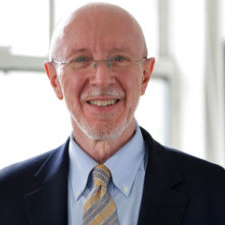
Frank E. Yeomans, MD, PhD
Frank E. Yeomans, MD, PhD, is a Clinical Associate Professor of Psychiatry at the Joan and Sanford I. Weill Medical College and Graduate School of Medical Sciences of Cornell University. He is a Senior Consultant in and teaches internationally for the Personality Disorders Institute, and is in private practice in White Plains and New York City.