
TFP-UK
29 October 2026
Registration end date: 28 October 2026
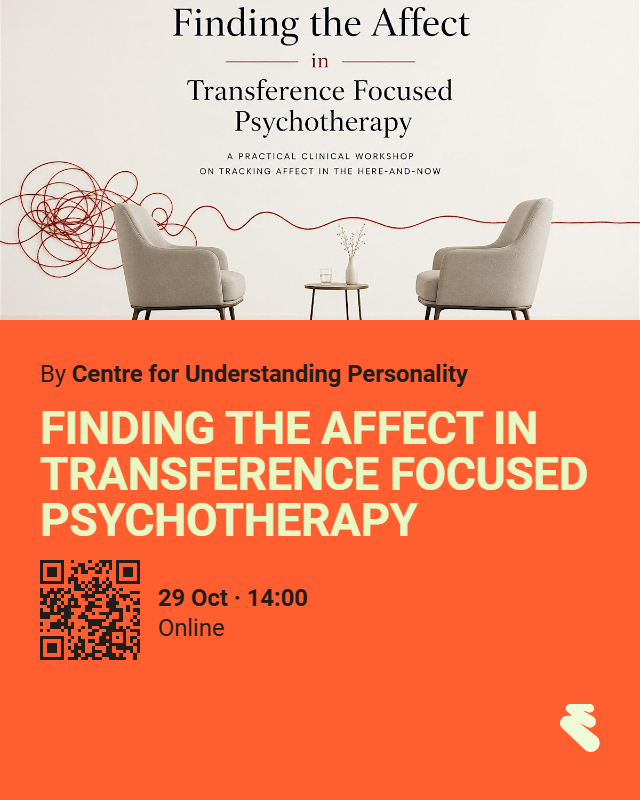
Finding the Affect in Transference-Focused Psychotherapy: A Practical Clinical Workshop on Tracking Affect in the Here-and-Now
English – Online
Joanna Bilińska-Gorzelnik, Tennyson Lee
Email your application by following the registration link
Description
Psychotherapists often find themselves feeling lost during sessions. Some patients overwhelm us with stories, associations and detail; others bring almost no material at all. At other times, we may be drawn into the patient’s intellectual formulations or explanations. In each case, the same question arises: Where should the intervention begin?
Without a clear organising principle, our attention may be guided by our own curiosity, by the patient’s narrative, or by countertransference reactions rather than by the central emotional process. Transference Focused Psychotherapy offers a simple but highly disciplined answer: follow the affect.
In TFP, affect is not understood simply as what the patient consciously reports feeling. It is the emotional investment that signals the activation of internal object relations and guides the therapist towards the patient’s dominant conflict and defensive organisation as these emerge within the therapeutic relationship.
This workshop develops this way of thinking through detailed work with a real psychotherapy session reconstructed for teaching purposes and performed by an actor. Participants have the opportunity to learn how to recognise affect, think clinically about affect, tolerate moments when it is not immediately obvious, and discover where accurately following it may lead to.
Finally, the workshop places this clinical approach within the framework of contemporary neuropsychoanalysis. Drawing particularly on the work of Mark Solms, we will explore how current findings in affective neuroscience provide empirical support for one of TFP’s central technical principles: that careful attention to affect offers the most reliable guide to understanding the patient’s internal world. In this way, participants will see that following affect is not simply a clinical tradition, but an approach consistent with contemporary scientific models of how the brain processes emotional experience, learning and therapeutic change.
Objectives:
1. Describe the role of affect in TFP.
2. Recognise affect in complex clinical situations.
3. Formulate affect-focused interventions.
4. Apply the principle of following affect to identify underlying object relations and defensive processes within the therapeutic relationship.
5. Integrate contemporary neuropsychoanalytic findings into clinical practice.
Details of event:
Part I: Introduction to TFP and the principle of following affect.
Part II: Understanding affect in TFP.
Part III: Clinical workshop based on recorded psychotherapy material.
Part IV: Why Following Affect Works: A Neuropsychoanalytic Perspective.
Part V: Questions and discussion.
Modalities
29 October 2026
14:00–17:00 (London Time)
Admission Fees: from £54.88
Faculty
Joanna Bilińska-Gorzelnik
Tennyson Lee
Contact
If you have any questions contact Jess Atkinson at: [email protected]
Registration
Follow the link to register